
Abstract
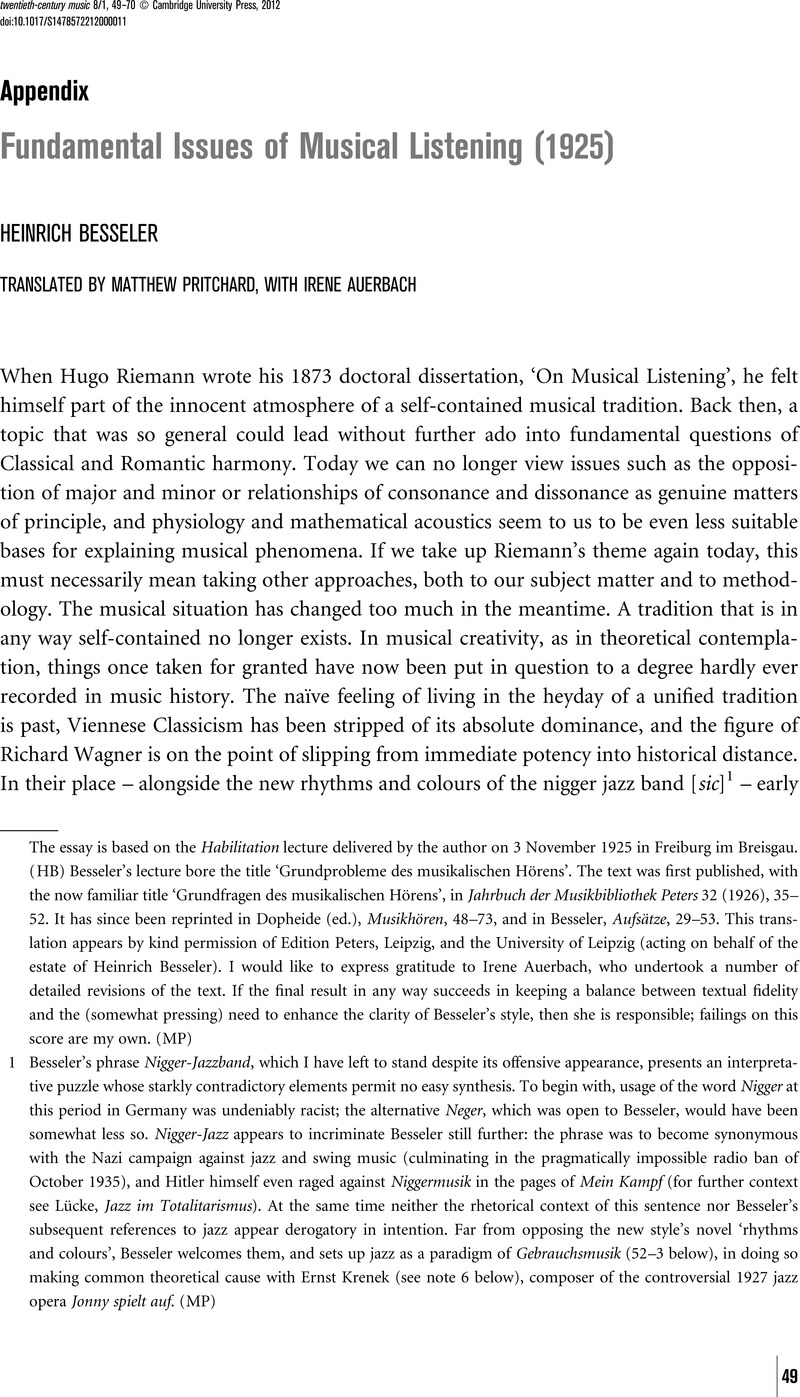
By examining the ideas expressed by the German musicologist Heinrich Besseler in his 1925 essay ‘Grundfragen des musikalischen Hörens’, this article attempts to find precedents in Weimar Germany for a contemporary social conception of music, and to trace the effects of this conception on music history between the wars. Although Besseler's position is seen to be complex and not wholly consistent, from his ideal of music as an expression of community (Gemeinschaft) arose two influential claims: that the concert was in crisis because it could no longer correspond to that ideal, and that the real source of communal vitality lay in Gebrauchsmusik, music for everyday use. The article explores the immediate political and musical consequences of these claims, both for the German youth music movement (Jugendmusikbewegung) and for Gebrauchsmusik as composed by Weill, Hindemith, and Eisler. It argues that the social aims of the Gebrauchsmusik movement were in fact best met when combined with an earlier understanding, rejected by Besseler himself, of the concert's own ‘community-forming power’ – a theoretical combination that was to lead outside Europe to the American musical and the Soviet symphony. By contrast, the sidelining of such ideas in post-war Germany was reflected in Adorno's outright rejection of musical community, a move which served to confirm only Besseler's first, negative claim – thereby establishing as normative an ‘autonomous’ conception of concert music and leaving musicology unable to give any positive account of the concert's social role.
Matthew Pritchard currently holds a British Academy postdoctoral fellowship at the Faculty of Music, University of Cambridge. His PhD dissertation, ‘Melody in Late Beethoven’, was completed in 2009 at Royal Holloway, University of London, and supervised by Nicholas Cook. This has led on to his current research project, entitled ‘The Analysis of Feeling: Motive and Metaphor in European Music 1750–1950’, which surveys the history and theory of the ‘motive’ in music from the mid-eighteenth century to Schenker, Schoenberg, and beyond. Since a year spent at Visva-Bharati University in West Bengal (2009–10) he has also been developing a separate research focus on Bengali music, specifically Rabindrasangit, the music of Rabindranath Tagore (1861–1941).